
Written by
AI in the Workplace: What 3,000 Workers Reveal About AI Adoption in 2026
A 2026 study conducted by Sonara reveals the full extent of AI in the workplace, including how workers are using AI at their jobs and how they feel about AI in hiring and promotion decisions.


9 min read
| Last Updated |

Table of Contents
Share this page


Until recently, the idea of AI in the workplace sounded more like science fiction, or at best, a developing innovation just on the horizon. Yet, a new report from Sonara suggests that AI tools have become a staple in the workplace.
Based on responses from more than 3,000 U.S. workers, Sonara’s AI in the Workplace Report shows that a clear majority are already using AI on the job, and 77% say it helps them do their work better. Among other key findings:
- AI is most often used to support core skills. The most common uses include writing or editing (69%), brainstorming ideas (53%), and data analysis or reporting (29%).
- AI is influencing hiring and advancement. More than half of workers (55%) believe AI tools were used to evaluate them during a recent job or promotion.
- Skills anxiety is driving adoption. Only 29% believe their skills are fully aligned with the future of work.
In this article, we examine new survey data on how U.S. workers are using AI tools on the job and how they feel about AI’s growing role in hiring and promotion decisions. We also outline practical steps that workers and job seekers can take to navigate the growing prevalence of AI at work with greater clarity and confidence.
AI Use at Work Is Now Mainstream
Using AI at work is no longer limited to early adopters or tech-driven businesses.
Sonara’s survey found that 70% of workers say their employer allows AI tools, and more than one-third (37%) report that AI use is actively encouraged. Even among the 30% of workers whose employers don’t allow it, a small but notable 5% say they use AI tools for work anyway.
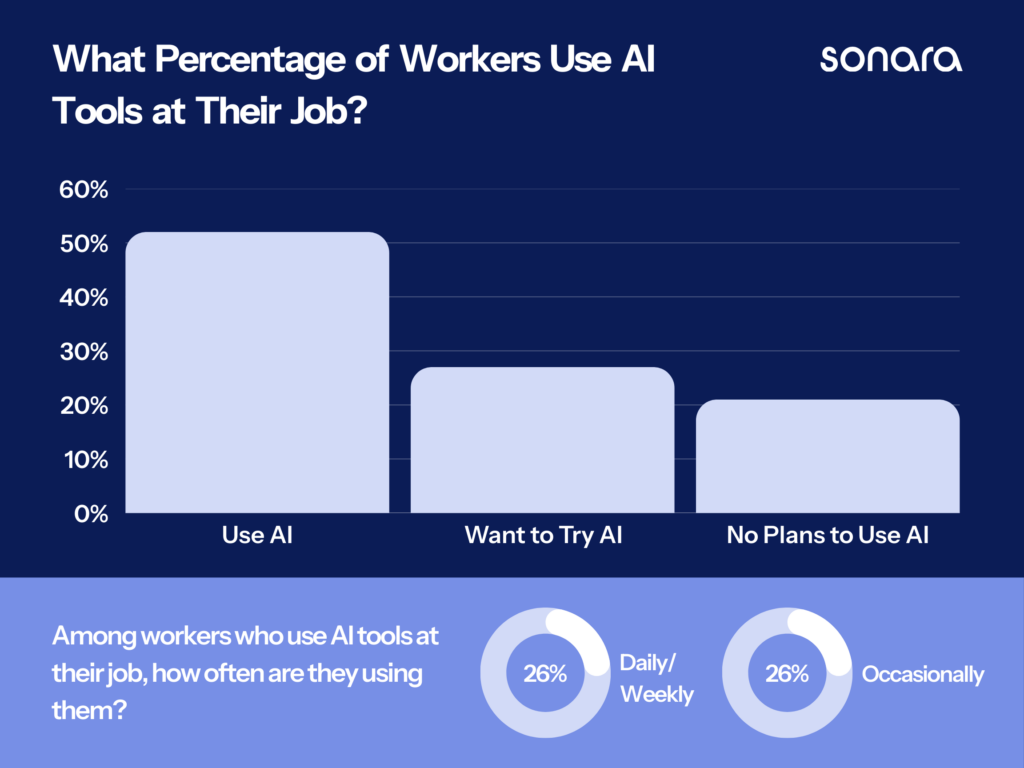
Adoption levels further reflect this shift, as illustrated in the graphic below:
- 52% say they use AI tools.
- 26% say they use AI tools daily or weekly.
- 26% say they use AI tools occasionally.
- 27% say they haven’t tried it but want to.
- 21% say they don’t plan to use it.
All told, nearly 80% of workers say they use AI or want to use AI at their jobs. The scale of usage and interest reinforces just how normalized these tools have become.
Workers Say AI Makes Them Better at Their Jobs
With many already using AI tools at work, the data provides insight into its perceived impact, and the results are quite positive. More than three-quarters (77%) say AI helps them perform their jobs better, compared to 18% who report no noticeable impact and 5% who say AI makes their work harder.
How it’s being used provides helpful context to this favorable impression. Respondents to the survey say they use AI at work in a variety of ways:
- Writing or editing: 69%
- Brainstorming: 53%
- Data analysis or reporting: 29%
- Design or image generation: 21%
- Note-taking: 19%
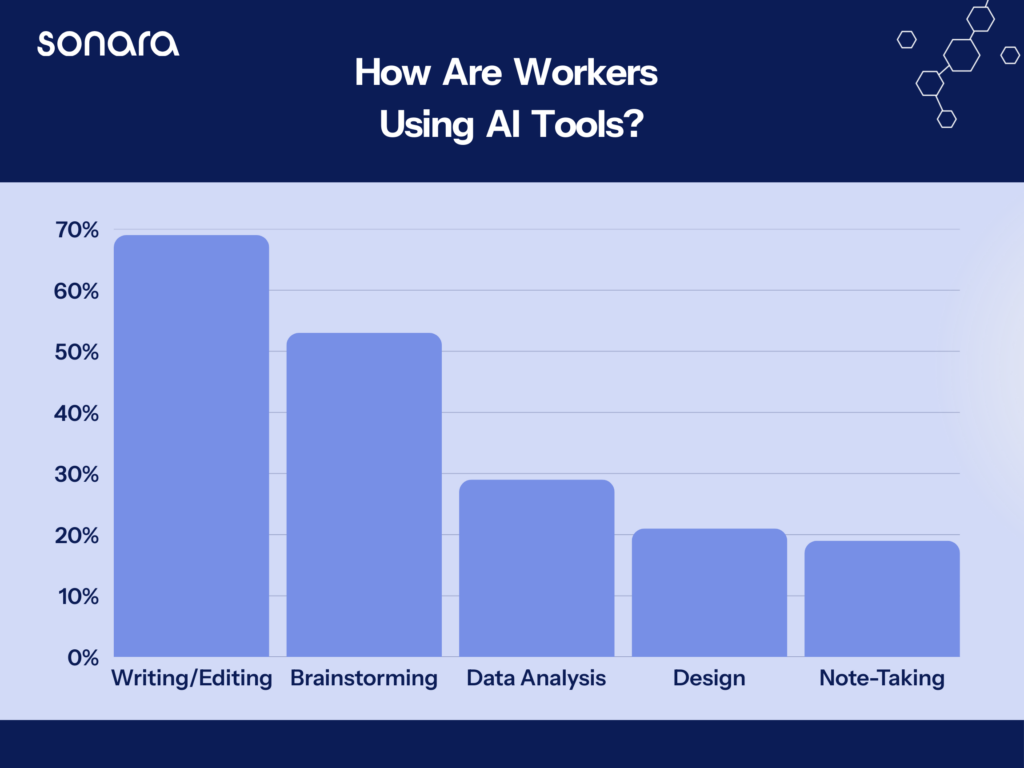
This diversity in AI use, shown in the image above, reflects how AI can augment skills and complement responsibilities rather than replace them. Workers are using AI as an assistive layer, helping them think, communicate, organize, and achieve their goals.
AI Is Reshaping Hiring & Workers Feel Unprepared
AI’s influence in the workplace goes beyond role responsibilities and into hiring and career advancement.
More than half of surveyed workers (55%) believe AI tools were used to evaluate them during a recent job application or promotion. This hasn’t been embraced with open arms either, as 60% say they’re uncomfortable with AI in hiring or promotion decisions.
This discomfort extends to broader anxiety among workers about their own skills as AI increasingly plays an important role in the workplace:
- Only 30% believe their skills are fully aligned with where the job market is headed.
- 56% say their skills are only somewhat aligned.
- 14% say they’re not aligned at all.
Without a doubt, uncertainty is a persistent concern for job seekers and workers. The question then becomes, what can they do to feel more confident using AI at work?
What Job Seekers Should Do Now
The growing presence of AI in hiring and the workplace can feel like a strange, new, and scary barrier to job seekers. But the data suggests something more hopeful, accessible, and practical: AI literacy is becoming less about technical expertise and more about everyday work habits.
According to Keith Spencer, a career expert at Sonara:
In 2026, the question isn’t if AI is being used but how. For companies, this means using AI responsibly and transparently in the hiring process. For workers and job seekers, it means communicating and leveraging AI responsibly in job applications and at work.
Being able to explain how you use AI to support your skills, improve your workflow, or make better decisions can help employers see not just what you know, but how you work and how you’re aligned with current workplace AI trends.
For job seekers, that shift comes with clear opportunities.
1 Embrace AI as a Job Search Tool, Not Just a Work Tool
AI can be applied across the job search process, not just to how work gets done once you’re hired. Used intentionally, AI job search tools can automate many time-consuming steps and help you stay focused on roles that are actually a good fit.
AI can support your job search by helping you:
- Filter and identify roles that match your qualifications and interests.
- Build and refine resumes, including optimizing for applicant tracking systems (ATS).
- Organize your applications and track your progress.
- Auto-apply for jobs, including multiple roles at once.
By reducing monotony and administrative friction, these tools can give you more time and energy to focus on strategy, fit, and the finer details that matter most.
2 Be Transparent About AI Use—Frame It as a Skill
As AI becomes more visible in the workplace and hiring, silence about how you use it can be just as telling as misuse. Rather than hiding AI use, job seekers can reframe it as a skill that supports stronger work.
When discussing AI use, focus on how it helps you:
- Improve accuracy
- Streamline workflows
- Support clearer communication
- Make better-informed decisions
Explaining when and why you use AI helps shift the focus away from the tool itself and toward the judgment behind it, giving employers insight into how you work and how that approach benefits the organization.
3 Highlight the Skills AI Can’t Replace
Even as AI adoption grows, the survey data shows that workers are using these tools to support—not replace—core skills, such as critical thinking, communication, empathy, and strategic judgment. AI is most effective when it works alongside these human strengths.
Rather than framing AI as competition, think of it as collaboration. Job seekers can stand out by showing how their judgment guides the tool and shapes its output.
This might include explaining how you:
- Develop and refine prompts
- Interpret or validate AI-generated results
- Apply context, nuance, or human insight
- Make final decisions based on experience and judgment
In many cases, it’s the human thinking around the tool—not the tool itself—that makes the biggest difference.
4 Use AI to Build Skills & Stay Competitive
If you’re worried your skills may not fully align with where the job market is headed, AI can make upskilling and reskilling more accessible. These tools can help identify areas for growth, structure learning plans, set up practice projects, and even generate exercises that allow you to build skills and develop real examples of your work.
A useful starting point is to look at the skills you already have and consider how AI might help you strengthen them.
- Writers can use AI to support drafting and editing.
- Data analysts can explore ways AI speeds up analysis or processing.
- Customer service professionals might use scenario-based tools to practice responses and receive feedback.
Over time, these efforts can translate into clearer evidence of learning and initiative.
And if you’re unsure where to begin, AI itself can help surface ideas, offering suggestions that make the path forward feel more manageable rather than overwhelming.
AI Tools Have Changed the Workplace
The findings from Sonara’s AI in the Workplace Report make one thing clear: AI is no longer a fringe technology at work. It’s already shaping how people perform their jobs, how they’re evaluated, and how confident they feel about their future skills.
As AI becomes more common across workplaces, it’s also increasingly part of the job search process. For candidates, success isn’t about avoiding AI or blindly embracing it; it’s about understanding how these tools fit into modern work and using them intentionally.
About Sonara
Sonara’s AI job search tool revolutionizes the job search by continuously scanning millions of job opportunities to identify the best matches and apply for users until they’re hired. By automating the process, the innovative platform alleviates tedious and time-consuming tasks associated with traditional job hunting, allowing workers to reclaim their time and increase their chances of finding their dream job. Sonara’s responsible AI algorithms personalize every step of the job search process and keep job seekers in control. From matching roles based on skills, experience, and preferences to generating tailored applications for every position, the platform ensures maximum relevance and impact by enabling applicants to review, approve, and submit up to 10x more applications than traditional job search methods, dramatically increasing candidates’ chances of success—all with a few simple clicks. Founded in 2020, Sonara is a trusted AI and workplace resource that has been featured on Business Insider, CBS News, Forbes, The Wall Street Journal, WIRED, and many more. For the latest updates and to stay connected, follow Sonara on Instagram and LinkedIn.
Share this page
Written by
See more articles from