
Written by
Top 10 In Demand AI Powered Jobs for 2026
Discover the top 10 AI-powered roles for 2026, and learn how to master the tools that turn AI skills into your ultimate professional edge.


11 min read
| Last Updated |

Table of Contents
Share this page


In an era of rapid technological shifts, navigating the job market can feel like trying to hit a moving target. Most of that movement is being driven by one thing: artificial intelligence (AI). Whether it’s how we write code or manage a team, AI is behind many changes.
If you’re feeling the pressure of “AI-proof” expectations or uncertainty about how your role might evolve, you aren’t alone—but you also aren’t powerless. The key to long-term career security is less about avoiding automation and more about mastering the tools that drive it.
But where exactly should you focus your energy? We’ve rounded up the top AI-powered jobs in demand for 2026 to give you a clear starting point. Below, we’ll explore these high-growth roles and share insights to help you move forward with confidence.
What Are AI-Powered Jobs?
AI-powered jobs are those that embrace automation rather than avoid it. These roles center on using AI to amplify human output, making workers more valuable and resilient as the market evolves.
And the shift toward these types of jobs is already underway. Recent data from Sonara shows that 79% of professionals already use AI tools at work or are interested in adopting them, with 77% saying that these technologies significantly improve their performance. Embracing AI is no longer a niche advantage; it’s becoming the new standard for professional growth and career longevity.
What AI Jobs Are in Demand? 10 Jobs
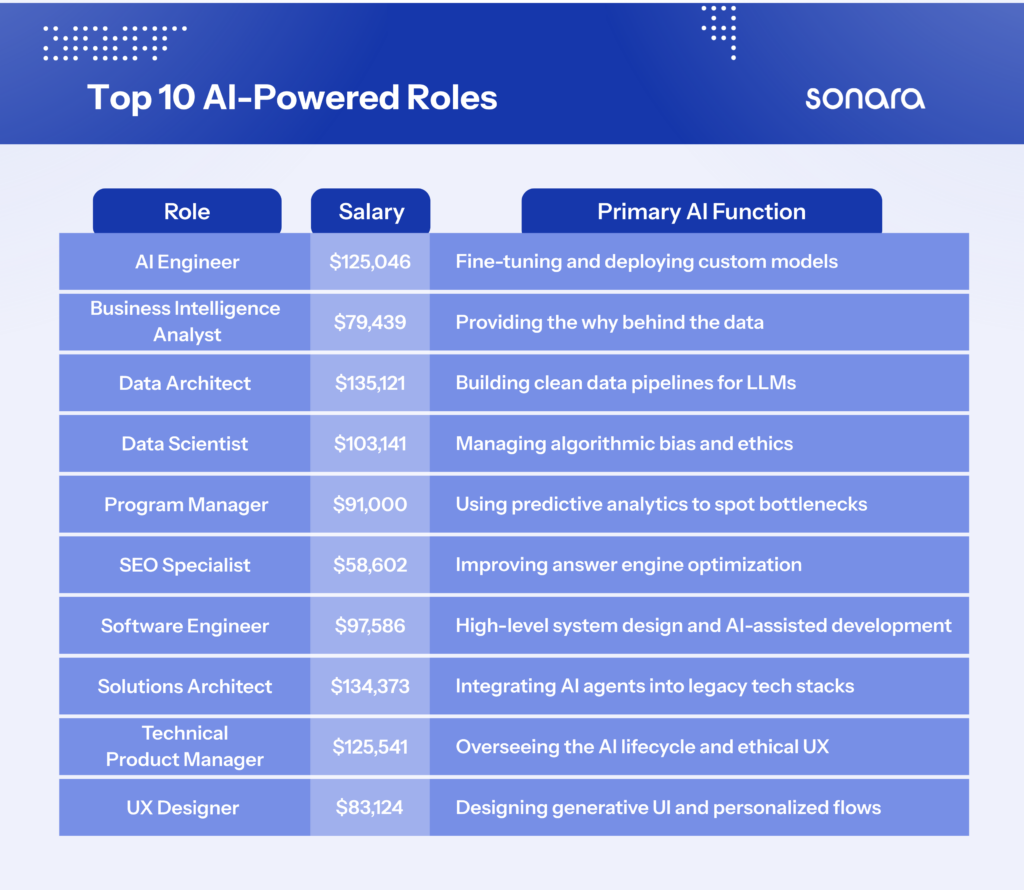
In 2026, the most in-demand roles are those that successfully blend human oversight with AI efficiency. Sonara analyzed employment data and AI adoption trends from the past year, along with current Payscale salary trends, to identify 10 top jobs that have evolved from traditional tech positions to AI-powered career paths.
1. AI Engineer
- Average salary: $125,046
- Key technical skills/tools: PyTorch, OpenAI, Hugging Face
AI engineers are the builders who take raw code and turn it into functional tools. Instead of just writing software or fine-tuning AI models, they focus on building agentic workflows, or systems where AI can plan and execute multi-step tasks autonomously.
2. Business Intelligence Analyst
- Average salary: $79,439
- Key technical skills/tools: Tableau Pulse, Microsoft Power BI
Business intelligence analysts are dedicated to turning data into answers. Rather than spending the day building complex spreadsheets, these analysts use AI to quickly visualize market trends so they can help leadership make decisions based on facts rather than gut feelings.
3. Data Architect
- Average salary: $135,121
- Key technical skills/tools: Pinecone, Weaviate, Snowflake
Data architects are responsible for building the infrastructure that delivers clean, organized information to large language models (LLMs), ensuring these systems can produce reliable output that isn’t compromised by messy or outdated information.
4. Data Scientist
- Average salary: $103,141
- Key technical skills/tools: Databricks, MLflow, Google Vertex AI
Extracting actionable insights from massive, complex datasets is the primary mission of data scientists. While AI algorithms handle much of the heavy lifting for data cleaning and pattern recognition, human input is needed to ensure the results are fair and align with company values.
5. Program Manager
- Average salary: $91,000
- Key technical skills/tools: Asana Intelligence, Monday.com
Program managers use predictive analytics to spot schedule delays and resource bottlenecks weeks in advance. By automating routine administrative tasks and meeting minutes, individuals in this role can dedicate more time to team leadership, conflict resolution, and strategy.
6. SEO Specialist
- Average salary: $58,602
- Key technical skills/tools: Semrush, Jasper, LLMClicks
Search engine optimization (SEO) is no longer just about ranking in the number one spot on a Google search results page. It’s about answer engine optimization (AEO). SEO specialists now focus on how to make a brand’s information show up in AI chat citations (like ChatGPT or Perplexity).
7. Software Engineer
- Average salary: $97,586
- Key technical skills/tools: GitHub Copilot, Cursor, Bolt
The day-to-day workflow of software engineers now consists of using AI agents to handle syntax and boilerplate code. This allows them to focus on high-level system architecture, security guardrails, and user logic.
8. Solutions Architect
- Average salary: $134,373
- Key technical skills/tools: Amazon Bedrock, Terraform, LangChain
Designing the blueprint for a business’s digital infrastructure falls to the solutions architect. These experts are tasked with looking at a company’s legacy tech setup and figuring out how to plug in AI tools so different software systems can talk to each other.
9. Technical Product Manager
- Average salary: $125,541
- Key technical skills/tools: Productboard, Dovetail, Jira Product Discovery
Bridging the gap between engineering teams and customers, technical product managers oversee the entire lifecycle of AI-integrated products. Their role is increasingly focused on ensuring that the product’s features remain ethical, accurate, and useful to the end user.
10. UX Designer
- Average salary: $83,124
- Key technical skills/tools: Figma AI, Adobe Firefly
User experience (UX) designers are increasingly experimenting with generative user interfaces (UI), where the interface reshapes itself in real-time based on who’s using it. Instead of building one version of a dashboard, they design the rules and guardrails that allow an AI to generate the best version for each user.
How to Break Into AI-Powered Careers
According to Keith Spencer, a career expert for Sonara, finding a job in the AI-powered field is less about getting a new degree and more about changing how you show off your work:
Instead of presenting employers with a list of qualifications or competencies, highlight tangible examples of how you’ve used AI tools to develop effective solutions, streamline complex or time-consuming tasks, and generate new insights that inform decision-making. Demonstrating these applied skills can often say more about the value you bring to a role than formal education or certifications alone.
Showcase the Skills Employers Prioritize in 2026
In a market where software changes every few weeks, hiring managers have moved toward skills-based hiring. This means a project portfolio that shows your capabilities can carry more weight than a traditional diploma.
With that in mind, here are some of the skills employers value for AI-powered jobs:
- Prompt engineering: The ability to give an AI clear, detailed instructions so it produces a high-quality result on the first try
- Fact-checking: A “human-in-the-loop” skill where you can audit AI-generated work to spot errors, verify data, and ensure the tone is right for your audience
- Workflow automation: The knack for looking at a slow, manual task—like sorting emails or summarizing meetings—and picking the right AI tool to handle it automatically
- Data storytelling: The ability to ask an AI tool questions about a spreadsheet and then explain what those numbers mean for the business in plain English
Pursue Pathways for Non-Technical Professionals
If your background is in a field like teaching, sales, or art, you actually have a head start. You already understand the human side of the job—you just need to add an AI “power-up” to it.
Here’s how to add AI skills to your existing expertise:
- Try targeted learning. Instead of going back to school for four years, look for short courses that teach you one specific thing, like how to use AI for project management or marketing.
- Use what you already know. If you’re a great writer, don’t try to become a data scientist overnight. Instead, become a writer who knows how to use AI to research and draft content 5x faster.
- Bridge the “context gap.” AI understands data, but you understand people. Whether it’s a student’s frustration or a customer’s hesitation, you have the “why” that AI lacks. Position yourself as the translator who feeds that real-world context into the tools to make the results useful.
Understand How AI Is Reshaping Work Across Industries
AI isn’t taking over every job; it’s just changing the boring, repetitive parts. Here’s what that looks like for different industries:
- Healthcare: AI handles administrative scheduling and preliminary diagnostic scans, allowing medical professionals to focus more on patient care and complex decision-making.
- Finance: Middle-management tasks like reporting and performance monitoring are being flattened by AI, shifting those roles toward high-level strategy and team leadership.
- Marketing: AI now handles the heavy lifting of keyword research and initial drafting for social media campaigns, allowing creative teams to spend their time on high-level brand storytelling and building real emotional connections with customers.
5 Ways to Succeed in AI-Powered Careers
To successfully navigate the emerging AI job market, consider the following strategies:
1 Start Using AI Tools Now to Build Familiarity
Hands-on experience is the best way to understand what this technology can—and can’t—do. Instead of just reading about AI, try using it for small, daily tasks like summarizing a long article, drafting an email, or brainstorming a project outline. When you’re in an interview, being able to talk about how you’ve tested these tools shows you have a practical, curious mindset.
2 Identify AI Applications Within Your Current Role
Look for the busywork in your average week—the repetitive tasks like data entry, meeting notes, or basic scheduling. Research which AI tools can handle those specific chores. By automating the mundane parts of your current job, you establish yourself as a forward-thinking employee who knows how to use technology to free up time for more strategic work.
3 Focus on Skills That Complement AI
AI is excellent at analyzing data, but it still struggles with uniquely human skills. In your job applications, double down on your ability to lead a team through a crisis, build deep trust with a client, and make ethical decisions. The most valuable workers are those who can provide the empathy and strategic planning that automated tools lack.
4 Upskill Through Courses, Certifications, or Hands-On Projects
If you see a skill mentioned in a job description that you don’t have, don’t wait for a company to train you. Build new skills by taking a short online course or starting small AI-powered side jobs—like a blog or a simple automated newsletter. Being able to show a hiring manager a finished project is often more powerful than just listing a certificate on your resume.
5 Highlight AI Proficiency on Your Application Materials
Avoid vague terms like “AI-savvy.” Instead, use your resume to show the actual results of your work. Instead of saying you “Used AI for marketing,” add specificity and quantifiable results: “Used AI-driven tools to research new audience trends, leading to a 10% increase in customer engagement.”
Making your achievements measurable proves to an employer that your AI skills will add immediate value to their team.
Next Steps Toward a Balanced Career
Finding a career that feels both stable and rewarding takes intention, but you don’t have to do the heavy lifting alone. Instead of losing hours to manual job boards and repetitive forms, you can use the same AI technology discussed in this article to transform your job search.
AI-powered platforms like Sonara act as a personal career assistant, automating the job application process so you can apply faster and focus on the human side of your career: preparing for interviews and connecting with your future team. By scanning millions of opportunities, Sonara also matches you with roles that align with your specific skills, helping you target the positions that matter most.
About Sonara
Sonara’s AI job search tool revolutionizes the job search by continuously scanning millions of job opportunities to identify the best matches and apply for users until they’re hired. By automating the process, the innovative platform alleviates tedious and time-consuming tasks associated with traditional job hunting, allowing workers to reclaim their time and increase their chances of finding their dream job. Sonara’s responsible AI algorithms personalize every step of the job search process and keep job seekers in control. From matching roles based on skills, experience, and preferences to generating tailored applications for every position, the platform ensures maximum relevance and impact by enabling applicants to review, approve, and submit up to 10x more applications than traditional job search methods, dramatically increasing candidates’ chances of success—all with a few simple clicks. Founded in 2020, Sonara is a trusted AI and workplace resource that has been featured on Business Insider, CBS News, Forbes, The Wall Street Journal, WIRED, and many more. For the latest updates and to stay connected, follow Sonara on Instagram and LinkedIn.
Share this page
Written by
See more articles from